The Nobel Prize-winning scientist Peter Higgs’s signature achievement was to solve a conundrum about what made the physical universe possible. Sixty years on, the pioneering theoretical work he and his peers did is driving ever-deeper investigations into the past and future of the cosmos.
Higgs’s ideas have had “a profound impact on our understanding of the universe, of matter and of mass”, said Alan Barr, professor of particle physics at Oxford university.
Higgs, who died on Monday aged 94, had an unusual scientific life of three acts. The startling insights of his mid-thirties were followed by a lower-key remainder of his career in academia, until his retirement in 1996.
Then, in 2012, came confirmation of the existence of the particle known as the Higgs boson and its associated force field — just as Higgs had predicted. Now Cern, the European Organization for Nuclear Research, is considering a €16bn expansion project in part to investigate the properties of this cosmically consequential discovery.
“The concept of the Higgs field and the Higgs boson is unique in particle physics,” said Mark Thomson, professor of particle physics at Cambridge university and the UK candidate to be Cern’s next director-general. “It is unlike anything else we have seen.”
Higgs was born in Newcastle upon Tyne in 1929, and schooled in the West Midlands, Bristol and London. In Bristol he attended Cotham Grammar School, where stories of a former pupil named Paul Dirac inspired him. Dirac was a founding theoretician of quantum mechanics who had jointly won the Nobel Prize in physics in 1933.
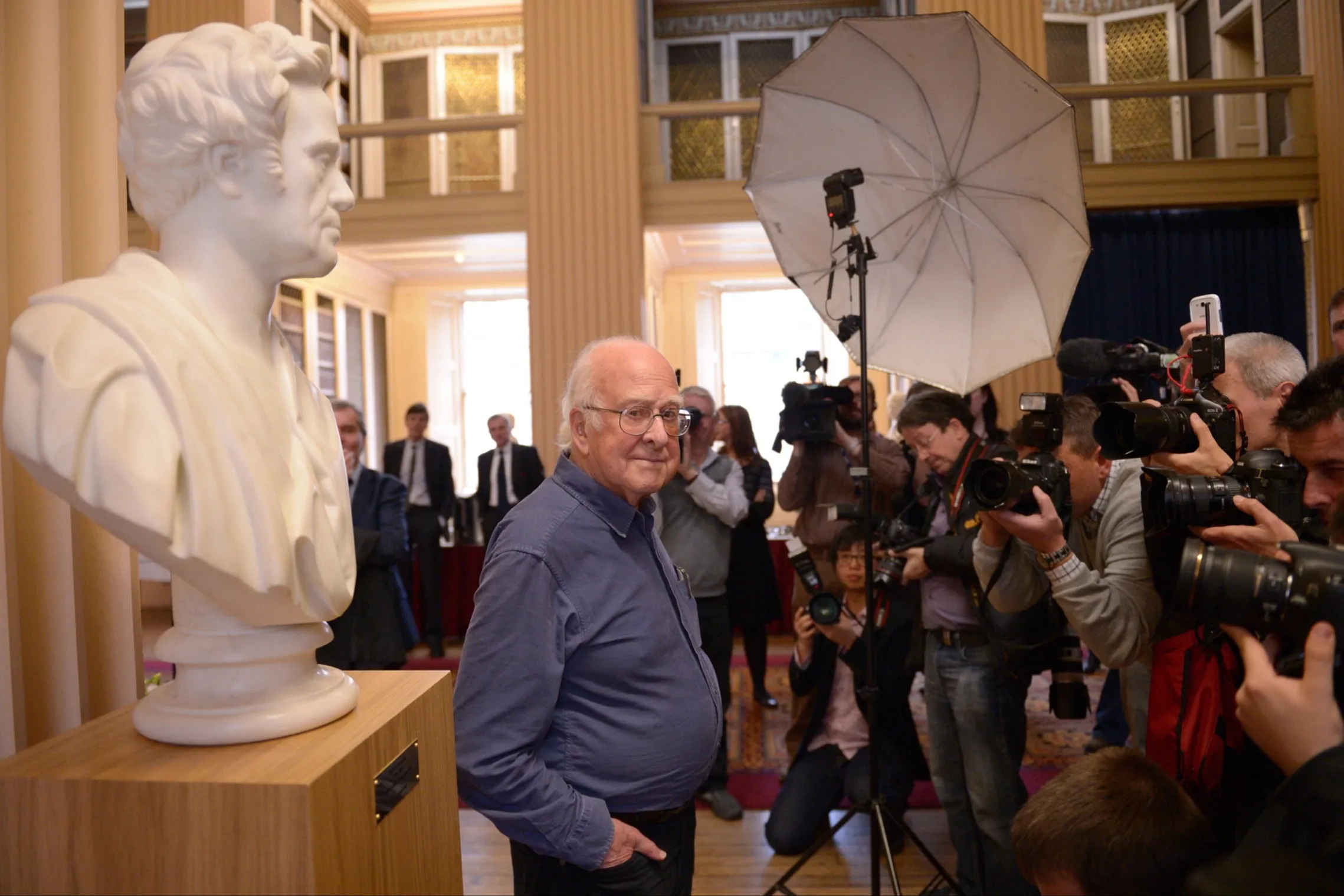
Higgs at Edinburgh university in 2013 after being awarded the Nobel Prize in Physics
Jeff J Mitchell/Getty Images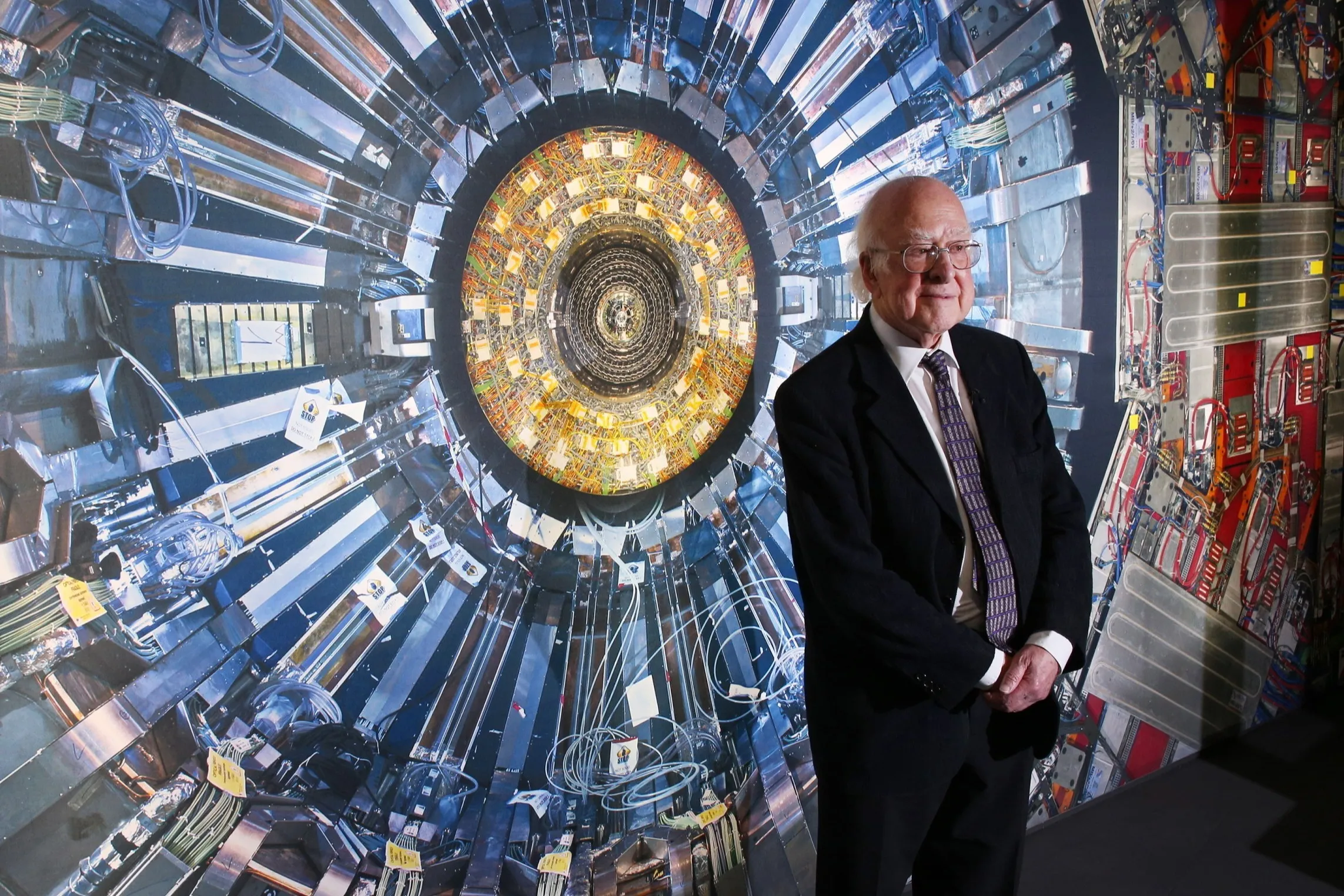
Higgs stands in front of a photograph of the Large Hadron Collider at the Science Museum in London in 2013
Peter MacDiarmid/Getty Images“I was curious about what he had done because his name appeared frequently on the roll call of the achievements of former pupils,” Higgs later recalled. “And that led me to read about atomic physics and quantum theory before I was ever taught them.”
Higgs graduated with a physics PhD from King’s College London and spent most of his academic career at Edinburgh university. At Edinburgh, he turned his mind to a fundamental puzzle. He worked in the strange realm of the subatomic, where the classical Newtonian physics of falling apples breaks down.
Models of the universe of subatomic particles struggled to account for why some of them must have mass — that is, they are made of matter. This was a problem: if none of them had mass, they could not combine to create stars, planets or life forms that did.
The answer, Higgs concluded, lay in a force field that permeated the universe. He thought an as-yet unidentified particle carried a force from this field that interacted with other particles to give them mass: in a sense, it defined them.
Higgs later used the simplified analogy of a snowfield — the force field — being traversed by people — other particles — wearing skis, snowshoes and normal boots. They move at differing speeds through the area, governed by how they interact with the snow.
One of Higgs’s early papers was rejected by a scientific journal. This perhaps reflected what the researcher saw as a perception among some Edinburgh colleagues that his ideas were, as he said in an interview, “a bit eccentric, maybe cranky”.
He refined his concepts — crucially predicting the Higgs boson — while other theoreticians produced their own groundbreaking work at the same time. When he won the 2013 Nobel Prize for this work, he shared it with the Belgian theoretical physicist François Englert.
The physicist famously went out for lunch on the day of the Nobel announcement to avoid media attention. He was generally a retiring character who once said the exposure from the award ruined his life.
Higgs’s theoretical work after his breakthrough perhaps inevitably failed to touch the earlier heights, as the technicalities of his discipline developed without him. He later spoke about a period of depression when his marriage broke down in the 1970s. He talked, too, about friction in his relationship with his university over his union activities. He thought a main reason Edinburgh retained him was the possibility he would one day win a Nobel Prize.
That day duly came, at the age of 84 — confirming the importance of his work to our scientific exploration of the universe.
It showed that the cosmos was “filled with a weird essence called the Higgs field,” noted Frank Close, an emeritus professor of theoretical physics at Oxford university and author of a book about Higgs’s life and work.
“We need it like fish need water,” Close said of the extraordinary concept that Higgs envisioned. “Without it, nothing we know would exist.”