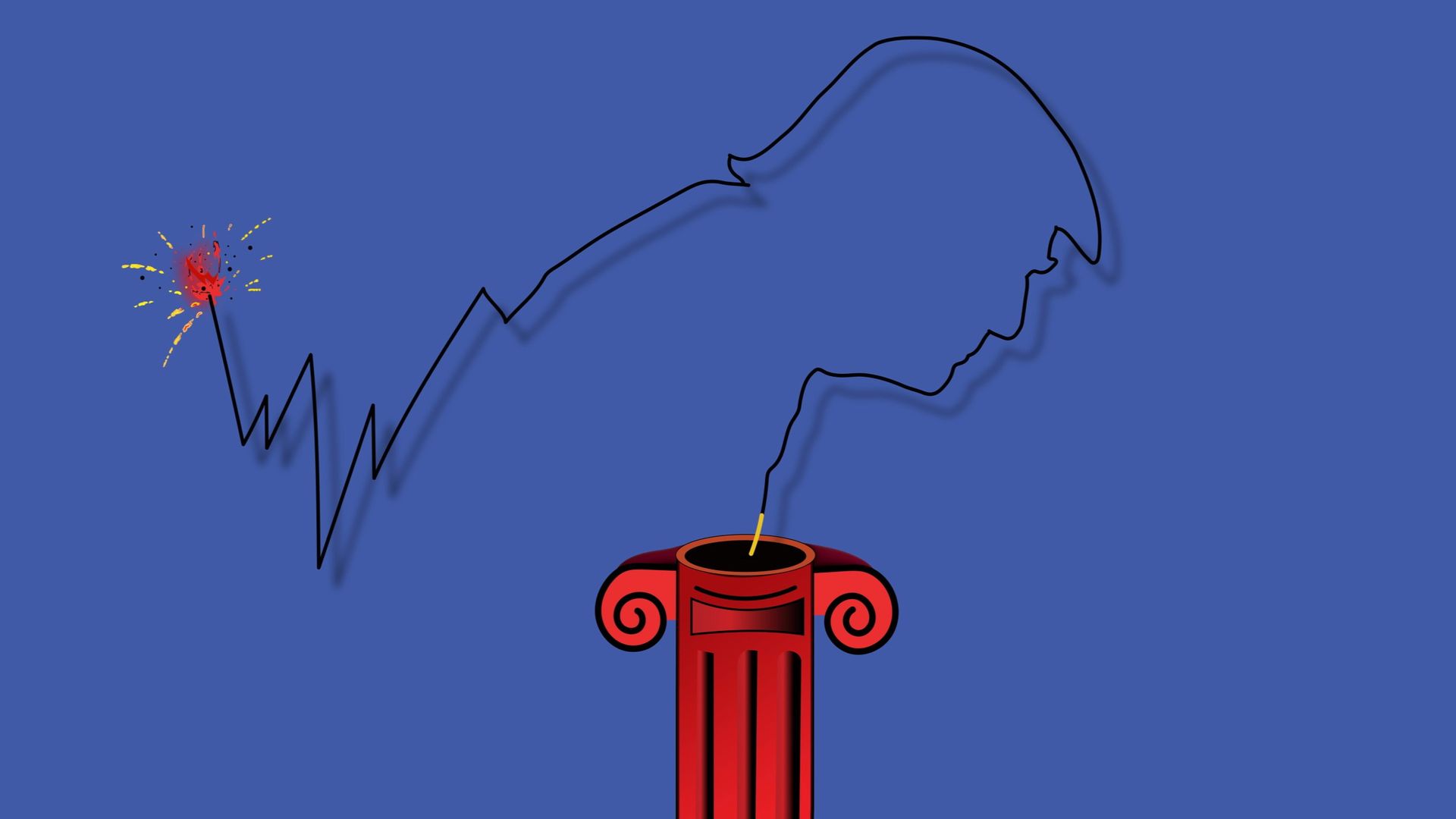
On Tuesday, while the US was voting, I heard a successful American businessman suggest at a dinner that the election could be framed as a choice between prioritising “capitalism” or prioritising “democracy”.
During the campaign, Democrats often derided Donald Trump for his perceived onslaught on democracy, while Trump attacked Kamala Harris for her allegedly pro-government, anti-capitalist stance. Hence those “Comrade Kamala” memes.
And while both candidates vehemently rejected those caricatures, the mudslinging seems to have stuck, at least in the minds of many business leaders and investors. Just look at the surge in stock prices after the election result, as investors concluded that Trump will be pro-growth and pro-business.
The capitalist aura looks especially strong given that Elon Musk, the entrepreneur and co-founder of Tesla, is set to be influential in the next administration, along with hedge fund managers such as Scott Bessent, a leading candidate to be the next Treasury secretary.
But as Trump selects his team in the coming weeks, the key question is what variant of “capitalism” the 47th president will uphold. The answer is not clear-cut.
When Republicans toss the concept around, they often invoke Adam Smith, the 18th-century Scottish intellectual who pioneered free-market ideas. When I visited then vice-president Mike Pence during the first Trump administration, the only books in his office were the Bible, his boss’s The Art of the Deal and those of Jack Kemp, a Smith-loving ex-American football player turned congressman.
Today, Trump continues to champion some of the concepts found in Smith’s 1776 classic The Wealth of Nations. He clearly believes in the power of profit-maximising incentives — or greed — to drive growth, echoing Smith’s concept of the “invisible hand”. He shares Smith’s distaste for excessive government interference and high taxes (though unfortunately he rejects Smith’s case for free trade).
And there is another, oft-overlooked, point: an appreciation of family firms. When Smith developed his ideas about markets, the only enterprises around him were family-owned ones (with the notable exception of the joint-stock East India Company, which Smith decried).
Today, however, the discourse around capitalism is dominated by listed companies and public markets. But ironically, a company such as the Trump Organization would have seemed more familiar to Smith than our modern listed corporate behemoths.
But the key issue investors now need to ponder is where Trump stands in relation to the other half of Smith’s free-market vision contained in The Theory of Moral Sentiments. Smith viewed this book as his most important work, since he believed the key to building dynamic commerce and markets is to create a system based on shared moral values and trust. That requires transparency, fair play and consistent property rights, since “if [justice] is removed, the great, the immense fabric of human society . . . must in a moment crumble into atoms”. In short, he saw corporate monopolies and capricious abuses of power as anti-capitalist.
Will Trump uphold that view too? There is reason to feel nervous. Musk presents himself as an arch capitalist, but has also spent his career railing against rules and seems untroubled by concentrations of power. Trump has faced multiple law suits, and has often appeared to have scant respect for legal contracts.
Meanwhile, figures such as Robert Lighthizer, Trump’s former US trade representative, have repeatedly threatened to rip up trade agreements. Bessent says that this rhetoric is just a negotiating ploy, intended to “escalate to de-escalate” — in other words, to scare opponents into submission. But I believe that a defining feature of the Trump approach is that it tends to embrace a situational, rather than universal, vision of the law. In other words, one that is shaped and applied by the context of power, not always in a uniform way. This runs counter to the ideals that have shaped much of the postwar western order. It is also at odds with the mantra of modern capital markets, which are supposed to be founded on consistent and predictable laws.
Some Trump supporters disagree with me and point out that the capital markets flourished during the first Trump presidency. They also insist that it is the Democrats, not the Republicans, who have weaponised the law with politically motivated prosecutions of Trump (which may now be dropped).
In any case, Bessent and others know what it takes to maintain the confidence of capital markets, having lived in them for years, and seem determined to avoid anything that might spark a financial crash. Indeed, fear of falling asset prices could help to rein Trump in and dissuade him from pursuing more radical ideas.
Yet as equity markets surge amid excitement at the election of a supposedly pro-business, “capitalist” candidate, investors should remember the two sides to Smith. Unfettered competition can certainly drive growth — even crony capitalism can produce a sugar high. But “moral sentiments” — trust and the rule of law — are essential for long-term prosperity. Let us pray that the next administration remembers this.